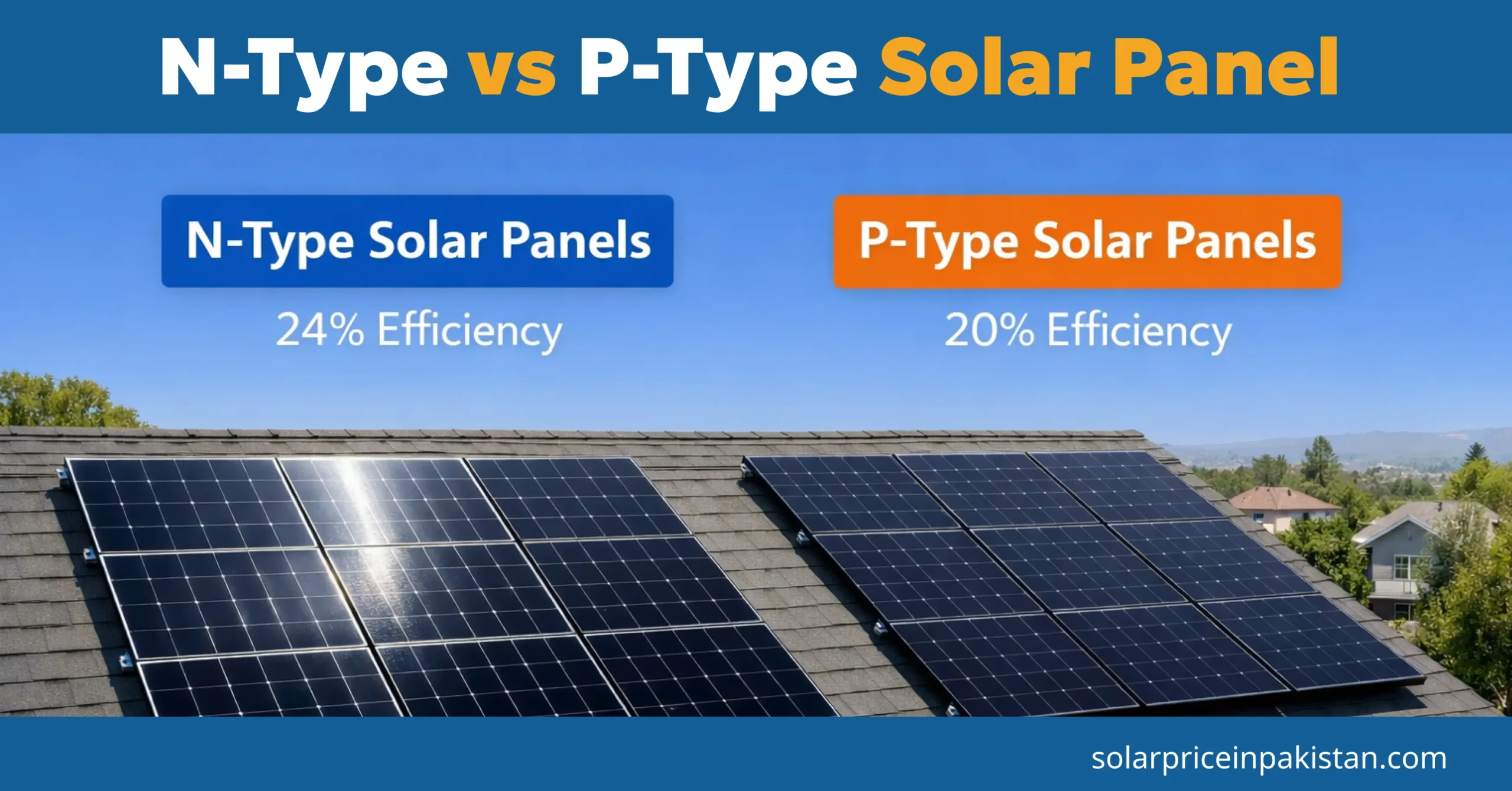
N Type vs P Type Solar Panels: Which Is the Best Choice in 2026?
N Type vs. P Type Solar Panels is a topic that continues to dominate the business as solar technology advances quickly in Pakistan and throughout the world. Knowing the differences between these two solar cell types is essential for optimizing efficiency, longevity, and return on investment, whether you’re establishing a commercial solar plant or a household rooftop system.
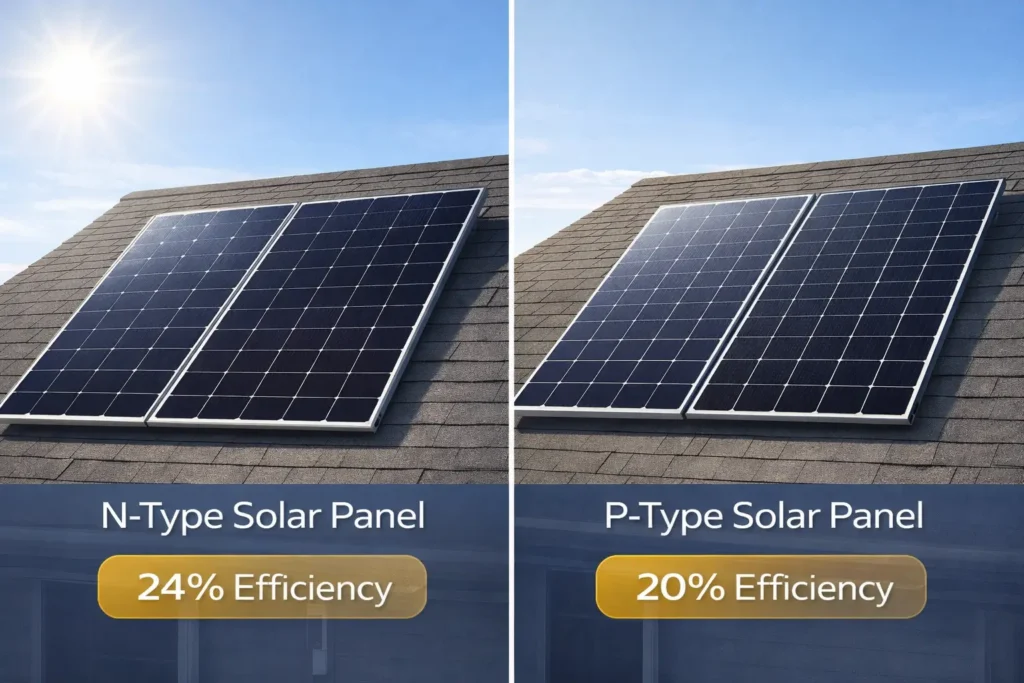
We will examine N Type and P Type solar panels in this thorough guide, including how they operate, how efficient they are, how much they cost in Pakistan, their benefits, their features, and which is best for you.
What Are N Type and P Type Solar Panels?
Silicon wafers doped with various compounds to produce positive (P-type) or negative (N-type) charge carriers are used in solar panels.
P Type Solar Panels
Boron-doped silicon is used in the production of P-type panels. Because they are widely available and reasonably priced, they are the most widely utilized solar panels in Pakistan.
N Type Solar Panels
Silicon wafers doped with phosphorus are used in N-type panels. They are thought to be more sophisticated and provide better performance, particularly in regions with high temperatures like Pakistan.
N Type vs P Type Solar Panels Difference
| Feature | N-Type Solar Panels | P-Type Solar Panels |
|---|---|---|
| Base Material | Phosphorus-doped silicon | Boron-doped silicon |
| Efficiency | Higher (22%–24%) | Moderate (18%–21%) |
| Degradation Rate | Lower (0.25% annually) | Higher (0.5% annually) |
| LID (Light Induced Degradation) | Very Low | Higher |
| Temperature Performance | Better | Moderate |
| Price | Higher | Lower |
| Lifespan | 25–30+ years | 20–25 years |
The N Type vs P Type Solar Panels efficiency comparison clearly shows N-type technology leading in performance and longevity.
How Do N Type and P Type Solar Cells Work?
N Type and P Type Solar Cell Structure
Solar cells use the photovoltaic effect to generate power.
- Sunlight hits the silicon wafer.
- Electrons get excited and move across the semiconductor junction.
- Electric current is generated.
Boron produces “holes” in P-type cells that permit current to flow.
Phosphorus increases the number of electrons in N-type cells, improving conductivity and lowering recombination losses.
N Type vs P Type Solar Panels Price Comparison in Pakistan (2026 Estimated)
Prices vary depending on brand, wattage, and technology (TOPCon, HJT, PERC).
N Type vs P Type Solar Panels Price in Pakistan
| Panel Type | Wattage | Price Per Watt (PKR) | Estimated Price (PKR) |
|---|---|---|---|
| P-Type Mono PERC | 550W | 28 – 32 | 15,400 – 17,600 |
| P-Type Poly | 540W | 26 – 29 | 14,000 – 15,600 |
| N-Type TOPCon | 575W | 32 – 36 | 18,400 – 20,700 |
| N-Type HJT | 580W | 35 – 38 | 20,300 – 22,000 |
Trending Keyword: TOPCon vs PERC solar panels Pakistan
N-type panels are slightly expensive but provide higher long-term returns due to better performance and lower degradation.
Key Features of N Type Solar Panels
- Higher energy conversion efficiency (up to 24%)
- Low Light-Induced Degradation (LID)
- Better temperature coefficient
- Higher bifacial gain (up to 85%)
- Longer warranty (up to 30 years)
- Advanced technologies like TOPCon & HJT
Key Features of P Type Solar Panels
- Affordable initial investment
- Widely available in Pakistan
- Proven and stable technology
- Suitable for small residential systems
- Easy replacement and compatibility
Product Specifications Comparison
| Specification | N-Type Panel | P-Type Panel |
|---|---|---|
| Efficiency | 22%–24% | 18%–21% |
| Temperature Coefficient | -0.29%/°C | -0.35%/°C |
| Warranty | 25–30 Years | 20–25 Years |
| Degradation (1st Year) | 1% | 2% |
| Annual Degradation | 0.25% | 0.5% |
| Bifacial Capability | Yes (Most Models) | Limited |
Advantages of N Type Solar Panels
✔ Higher Efficiency
More electricity generation per square meter.
✔ Better Performance in Hot Climate
Ideal for Pakistan’s high temperatures.
✔ Longer Lifespan
Lower degradation means higher total output over 25+ years.
✔ Better ROI
Although expensive initially, long-term savings are higher.
Advantages of P Type Solar Panels
✔ Lower Cost
Best for budget-conscious buyers.
✔ Easy Availability
Readily available across Pakistan.
✔ Proven Technology
Trusted for decades worldwide.
Capacity Comparison for Different System Sizes
| System Size | P-Type Panels Required (550W) | N-Type Panels Required (575W) |
|---|---|---|
| 5kW | 9–10 Panels | 8–9 Panels |
| 10kW | 18–20 Panels | 17–18 Panels |
| 15kW | 27–30 Panels | 26–27 Panels |
N-type panels reduce total panel count due to higher wattage and efficiency.
N Type vs P Type Solar Panel Efficiency
In Pakistan’s hot regions like Punjab and Sindh:
- N-type panels produce 3–5% more energy annually
- Better resistance to PID (Potential Induced Degradation)
- Less power loss in dusty environments
This makes them attractive for commercial and industrial installations.
Which Factors Should You Consider Before Buying?
1. Budget
If you want a lower upfront investment, choose P-type.
2. Space Availability
Limited roof space favors N-type due to higher efficiency.
3. Climate Conditions
Hot climates benefit from N-type technology.
4. Long-Term Investment Goals
If planning 20+ years usage, N-type is better.
N Type vs P Type Solar Panels: Which Is Better?
This is one of the most common questions: N Type vs P Type Solar Panels which is better?
Choose N-Type If:
- You want maximum efficiency.
- You have limited roof space.
- You want higher long-term returns.
- You are installing a hybrid or commercial system.
Choose P-Type If:
- You are on a tight budget.
- You need a small residential system.
- You want affordable installation.
Is N-Type Worth the Higher Price?
Yes—especially for:
- Net metering systems
- Hybrid solar systems
- Industrial solar plants
- Long-term investments (10+ years planning)
Although the initial price is 10–15% higher, the lifetime output is significantly better.
Conclusion
The debate of N Type vs P Type Solar Panels ultimately depends on your budget, installation space, and long-term goals. If you are aiming for maximum efficiency, durability, and better performance in Pakistan’s climate, N-type panels are the superior choice. However, if cost is your primary concern, P-type panels remain a reliable and economical option.
With advancing technologies like TOPCon and HJT becoming more affordable, N-type panels are gradually dominating the solar market in Pakistan.
Check the latest solar price in Pakistan. Click here
FAQs
What is the main difference between N Type and P Type Solar Panels?
The primary difference is silicon doping material — phosphorus for N-type and boron for P-type — affecting efficiency and degradation.
Are N-Type panels better in Pakistan?
Yes, due to better heat tolerance and lower degradation rates.
Which panel type is cheaper?
P-type panels are more affordable.
Do N-Type panels last longer?
Yes, typically 25–30 years with lower annual degradation.
Is TOPCon technology N-type?
Yes, most TOPCon panels are based on N-type silicon technology.