On-Grid vs Off-Grid Solar Systems: Which is Best in 2026
As electricity tariffs continue to rise and load-shedding remains a challenge across Pakistan, more homeowners and businesses are considering solar energy as a permanent solution. However, one of the most common questions consumers ask is: On-grid vs. off-grid solar systems—which should I choose?
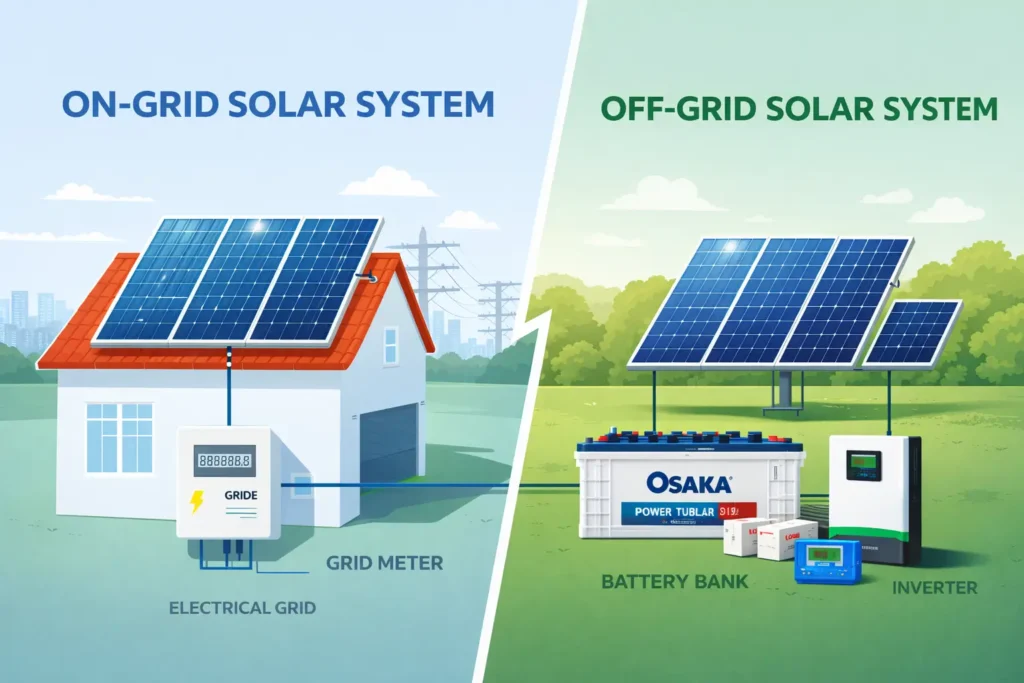
The answer depends on several factors: your location, budget, electricity consumption patterns, and tolerance for power outages. With an on-grid solar system that is directly connected to the WAPDA grid, you can use net metering to sell extra electricity to the utility company. Off-grid solar systems are ideal for isolated locations without grid access because they operate independently and rely on battery banks to store energy for nighttime and overcast-day use.
In this comprehensive guide, we will explore the complete on-grid vs off-grid solar systems comparison, including detailed pricing tables, technical specifications, and practical advice to help you make an informed decision for your Pakistani home or business.
What is an On-Grid Solar System?
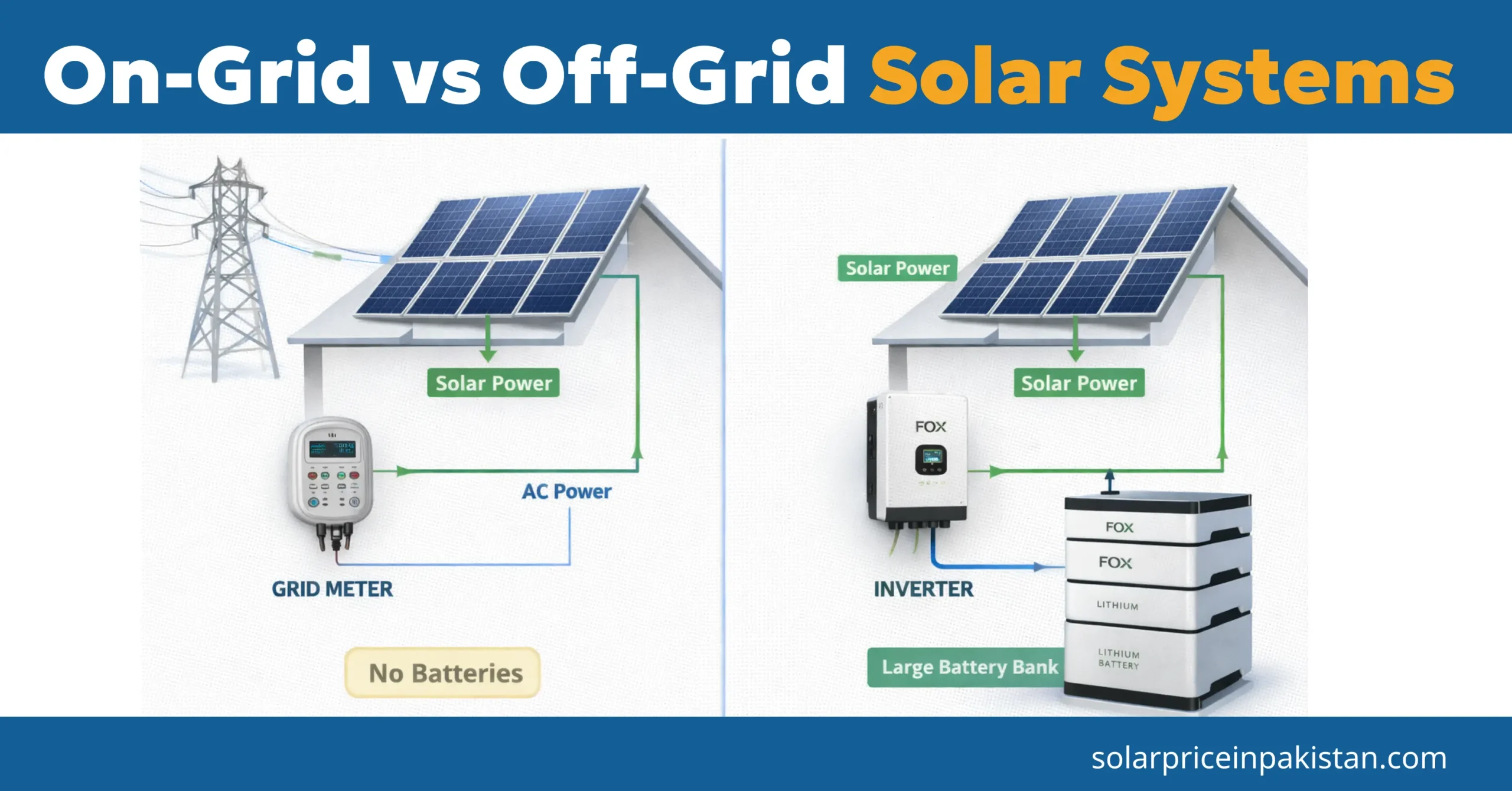
An on-grid solar system (also called grid-tied or grid-connected) is connected directly to the national power grid. It generates electricity from solar panels during daylight hours, supplies power to your home, and exports any excess energy to the grid.
Key Characteristics
| Feature | Description |
|---|---|
| Grid Connection | Directly connected to WAPDA grid |
| Battery Requirement | No batteries required |
| Net Metering | Yes—export excess energy for credits |
| Backup During Outage | No—system shuts down for safety |
| Ideal For | Directly connected to the WAPDA grid |
How On-Grid Systems Work
- Solar panels generate DC electricity from sunlight
- An inverter converts DC to AC power for home use
- Excess energy flows to the grid via net metering
- At night, you draw power from the grid using accumulated credits
- During grid outages, the system automatically shuts down (safety requirement)
What is an Off-Grid Solar System?
An off-grid solar system operates completely independently of the national power grid. It generates electricity from solar panels, stores excess energy in batteries, and provides power even when the grid is down.
Key Characteristics
| Feature | Description |
|---|---|
| Grid Connection | No grid connection—fully independent |
| Battery Requirement | Essential—large battery bank required |
| Net Metering | Not applicable |
| Backup During Outage | Yes—full power during any outage |
| Ideal For | Remote areas, unstable grid, complete independence |
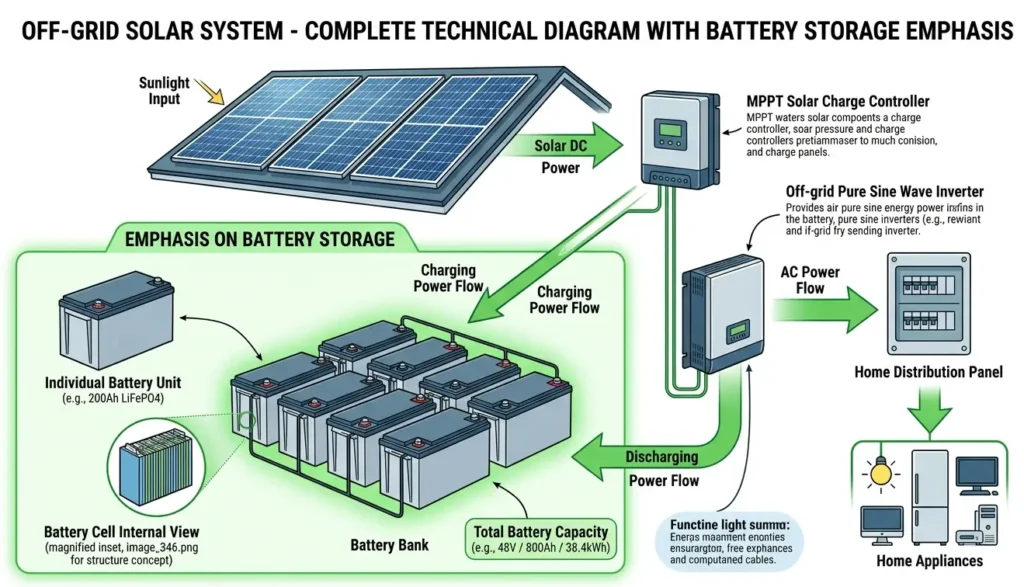
How Off-Grid Systems Work
- Solar panels generate DC electricity from sunlight
- A charge controller regulates battery charging
- Batteries store excess energy for later use
- An inverter converts DC battery power to AC for home use
- The system provides uninterrupted power during grid outages
On-Grid vs Off-Grid Solar Systems: Key Differences
| Feature | On-Grid System | Off-Grid System |
|---|---|---|
| Grid Dependence | Requires grid connection | Fully independent |
| Batteries | Not required | Essential (large bank needed) |
| Net Metering | Yes—export excess energy | Not applicable |
| Backup Power | No power during outages | Full backup 24/7 |
| Initial Cost | Lower (Rs. 350,000–800,000 for 4-7kW) | Higher (Rs. 600,000–1,500,000+) |
| Maintenance | Minimal (panel cleaning only) | Higher (battery maintenance/replacement) |
| Lifespan of Components | Panels 25+ years, inverter 10+ years | Panels 25+ years, batteries 5-8 years |
| Electricity Bills | Drastically reduced (up to 90-100%) | Zero (complete independence) |
| Space Required | Panels only | Panels + battery bank (significant space) |
| Best For | Urban areas with stable grid | Urban areas with a stable grid |
On-Grid vs Off-Grid Solar System Price in Pakistan 2026
The on-grid vs off-grid solar system price in Pakistan varies significantly based on capacity, component quality, and installation requirements.
Price Comparison by System Size
| System Size | On-Grid Price (PKR) | Off-Grid Price (PKR) | Price Difference |
|---|---|---|---|
| 3kW | 350,000 – 450,000 | 550,000 – 700,000 | +40-55% |
| 4kW | 450,000 – 600,000 | 700,000 – 900,000 | +50-55% |
| 5kW | 550,000 – 750,000 | 850,000 – 1,100,000 | +50-60% |
| 6kW | 650,000 – 900,000 | 1,000,000 – 1,300,000 | +50-55% |
| 8kW | 850,000 – 1,200,000 | 1,300,000 – 1,800,000 | +50-60% |
| 10kW | 1,000,000 – 1,500,000 | 1,600,000 – 2,200,000 | +50-60% |
Component Cost Breakdown
| 50-60% of the total cost | On-Grid System | Off-Grid System |
|---|---|---|
| Solar Panels | 50-60% of total cost | 35-45% of total cost |
| Inverter | 15-20% of total cost | 10-15% of total cost |
| Batteries | Not required | 30-40% of total cost |
| Mounting Structure | 8-12% of total cost | 5-8% of total cost |
| Installation & BOS | 10-15% of total cost | 10-15% of the total cost |
Capacity Recommendations
On-Grid System Sizing
| Home Size | Monthly Consumption | Recommended System Size | Daily Generation |
|---|---|---|---|
| Small (2-3 bedrooms) | 300-400 units | 3-4 kW | 12-18 kWh |
| Medium (3-4 bedrooms) | 400-600 units | 5-6 kW | 20-28 kWh |
| Large (4-5 bedrooms) | 600-800 units | 7-8 kW | 28-35 kWh |
| Very Large (5+ bedrooms) | 800-1,200 units | 10-12 kW | 40-55 kWh |
Off-Grid System Sizing
| Home Size | Daily Load | Recommended System Size | Battery Bank Capacity |
|---|---|---|---|
| Small (basic loads) | 5-8 kWh | 3-4 kW | 10-15 kWh |
| Medium (essential + fridge) | 8-12 kWh | 5-6 kW | 15-25 kWh |
| Large (multiple appliances) | 12-18 kWh | 7-8 kW | 25-35 kWh |
| Very Large (full comfort) | 18-25 kWh | 10-12 kW | 35-50 kWh |
Key Features Comparison
| Feature | On-Grid | Off-Grid |
|---|---|---|
| Net Metering Support | Yes | No |
| Backup During Load-Shedding | No | Yes (full backup) |
| Battery Storage | Not required | Essential |
| Grid Independence | No | Yes (complete) |
| Return on Investment (ROI) | 3-5 years | 5-8 years |
| Monthly Electricity Bill | Reduced by 80-100% | Zero |
| System Complexity | Simple | Complex (battery management) |
| Monitoring | Basic (energy production) | Advanced (battery status, load management) |
Specifications Comparison
| Specification | On-Grid Inverter | Off-Grid Inverter |
|---|---|---|
| Input Source | Solar panels only | Solar panels + batteries + grid (optional) |
| Output During Grid Failure | No output (safety shutdown) | Continuous output from batteries |
| Efficiency | 96-98% | 90-95% |
| Battery Charger | Not required | Built-in MPPT/PWM charger |
| Transfer Time | Not applicable | 5-20 ms (UPS mode) |
| Typical Brands | GoodWe, Growatt, Sungrow | Inverex, Knox, Primax, Fox |
| Warranty | 5-10 years | 2-5 years (inverter), 2-8 years (batteries) |
Advantages of On-Grid Solar Systems
1. Lowest Upfront Cost
On-grid systems are the most affordable option since they do not require expensive battery banks. The on-grid vs off-grid solar system price difference can be 50-60% in favor of on-grid.
2. Net Metering Benefits
Excess electricity exported to the grid generates credits that offset nighttime and cloudy-day consumption. With net metering, you can reduce your electricity bill by 80-100%.
3. No Battery Maintenance
Without batteries, there is no need for regular maintenance, water topping, or expensive battery replacements every 5-8 years.
4. Higher Efficiency
On-grid inverters typically achieve 96-98% efficiency, compared to 90-95% for off-grid inverters, because there are no battery charging losses.
5. Faster Payback Period
With lower upfront costs and net metering credits, on-grid systems typically achieve payback in 3-5 years compared to 5-8 years for off-grid.
6. Simple Installation
Fewer components mean faster, simpler installation and fewer potential points of failure.
Advantages of Off-Grid Solar Systems
1. Complete Energy Independence
Off-grid systems provide power even during grid outages, load-shedding, and blackouts. You are completely independent of WAPDA.
2. No Electricity Bills
Once installed, off-grid systems eliminate electricity bills entirely—no monthly charges, no tariff hikes, no surprises.
3. Ideal for Remote Locations
Off-grid systems are perfect for rural areas, farms, and locations where grid connection is unavailable or unreliable.
4. Protection from Tariff Increases
With an off-grid system, you are completely insulated from future electricity price hikes, which have been frequent in Pakistan.
5. Silent and Clean Operation
Unlike diesel generators, off-grid solar systems operate silently with no fuel costs, no fumes, and no maintenance headaches.
6. Energy Security
Off-grid systems provide true energy security—you have power regardless of grid conditions, natural disasters, or utility company issues.
Disadvantages of On-Grid Systems
1. No Power During Load-Shedding
The biggest drawback: during grid outages, on-grid systems automatically shut down for safety reasons, leaving you without power.
2. Dependent on Grid Stability
If the grid is unstable or frequently down, net metering credits may not fully offset your consumption, and you lose power during outages.
3. Net Metering Policy Risk
Government policies regarding net metering can change. Recent proposals to reduce buy-back rates from PKR 27 to PKR 10 per unit could affect ROI.
4. No Energy Storage
Without batteries, you cannot store solar energy for nighttime use—you rely entirely on grid credits.
Disadvantages of Off-Grid Systems
1. High Upfront Cost
The on-grid vs off-grid solar system price difference is substantial—off-grid systems cost 50-60% more due to battery banks.
2. Battery Replacement Costs
Batteries typically need replacement every 5-8 years, adding high long-term costs to off-grid systems.
3. Higher Maintenance
Off-grid systems require regular battery maintenance (water topping for lead-acid, BMS monitoring for lithium) and more complex troubleshooting.
4. Lower Efficiency
Energy is lost during battery charging and discharging (10-15% round-trip loss), making off-grid systems less efficient than on-grid.
5. Larger Space Requirements
Off-grid systems require space for both panels and battery banks, which can be significant (especially for lead-acid batteries).
Which One Should You Choose?
Choose On-Grid If:
- You live in an urban area with a stable grid supply
- Your goal is to reduce electricity bills and achieve a fast ROI
- You have a limited budget and want the lowest upfront cost
- You are comfortable with no backup during load-shedding
- You want a simple, low-maintenance solar solution
- You have access to net metering through your DISCO
Choose Off-Grid If:
- You live in an area with frequent load-shedding or no grid access
- You need uninterrupted power for critical appliances (medical equipment, business, etc.)
- You want complete energy independence from WAPDA
- You are willing to pay a higher upfront cost for peace of mind
- You have space for battery banks and can manage maintenance
- You want zero electricity bills forever
Hybrid Systems: The Best of Both Worlds?
For many Pakistani consumers, a hybrid solar system offers the ideal compromise. Hybrid systems combine the benefits of both on-grid and off-grid configurations:
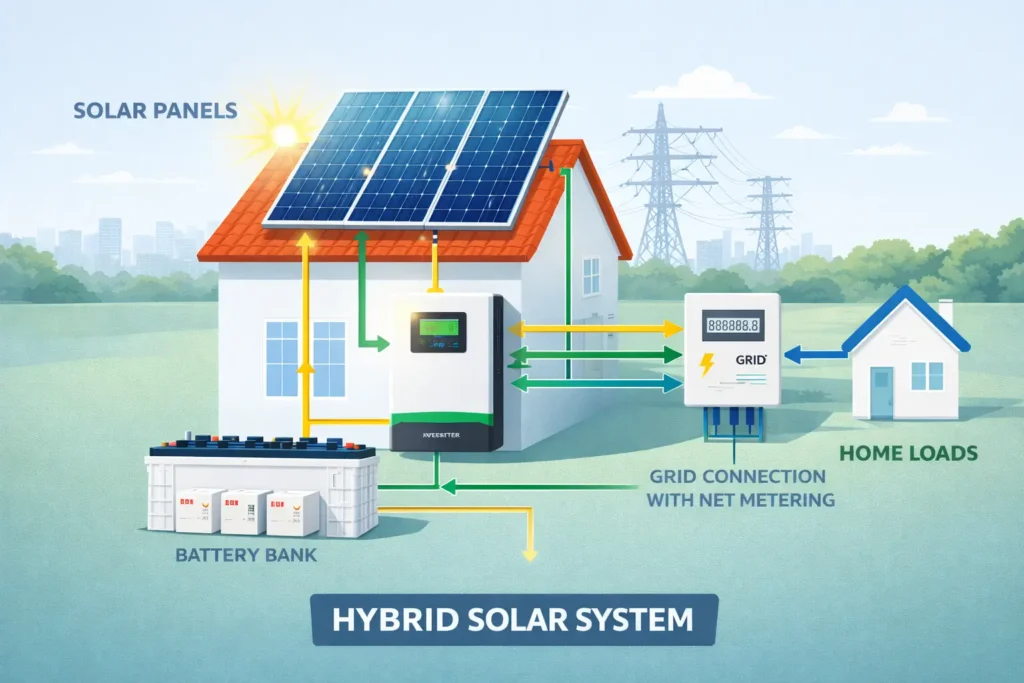
| Feature | Hybrid System |
|---|---|
| Grid Connection | Yes (net metering compatible) |
| Battery Backup | Yes (during outages) |
| Cost | Moderate (between on-grid and off-grid) |
| Best For | Areas with moderate load-shedding |
Hybrid systems allow you to:
- Export excess energy to the grid (net metering)
- Store energy in batteries for backup during outages
- Prioritize solar, then battery, then grid for optimal savings
- Scale your system by adding batteries later
Conclusion
Your specific needs, location, and budget will determine whether you choose on-grid or off-grid solar systems. On-grid systems with net metering provide the quickest return on investment, lowest initial cost, and easiest maintenance for the majority of urban Pakistani residences with reliable grid access—at the expense of no backup during load-shedding.
Off-grid systems offer genuine energy independence, uninterrupted power, and zero electricity bills for people living in places with regular outages or total grid absence, but they come with a much greater initial cost and continuing battery maintenance requirements.
In Pakistan, there is a significant (50–60%) pricing difference between on-grid vs off-grid solar systems, but there is also a functional difference. For many customers, hybrid systems provide the best compromise between net metering advantages and battery backup for blackouts, enabling you to begin with on-grid functioning and add batteries as your budget allows.
In the end, the best decision strikes a compromise between your budget and your tolerance for outages. On-grid is the obvious choice for cost savings if you can tolerate load shedding. Off-grid or hybrid systems are the only options if continuous electricity is required.
Check the latest solar price in Pakistan. Click here
FAQs
What is the difference between on-grid and off-grid solar systems?
On-grid systems connect to the WAPDA grid and use net metering to export excess energy. Off-grid systems operate independently with batteries and provide power during outages.
Which is cheaper: on-grid or off-grid?
On-grid systems are significantly cheaper—typically 50-60% less than off-grid systems of the same capacity because they don’t require expensive battery banks.
Can I convert from on-grid to off-grid later?
Yes, but it requires adding batteries, a charge controller, and potentially a new hybrid inverter. It’s more cost-effective to install a hybrid inverter initially if you plan to add batteries later.
Does on-grid solar work during load-shedding?
No. On-grid systems automatically shut down during grid outages for safety reasons. You will have no power during load-shedding.
How long do batteries last in off-grid systems?
Lead-acid batteries last 3-5 years, while lithium-ion batteries last 8-12 years, depending on usage depth and maintenance.
Is net metering available in Pakistan?
Yes, net metering is available through all major DISCOs (LESCO, IESCO, K-Electric, etc.), but requires application, approval, and a bi-directional meter.
Which system is better for Pakistan?
For urban areas with a stable grid, on-grid with net metering offers the best ROI. For areas with frequent load-shedding, a hybrid or off-grid system is better.
What is the payback period for on-grid vs off-grid?
On-grid systems pay back in 3-5 years through bill savings. Off-grid systems take 5-8 years due to higher upfront costs.
Can I run AC on off-grid solar?
Yes, but you need adequate battery capacity. A 5kW off-grid system with 10-15kWh batteries can run 1-2 ACs for several hours.
What happens to excess solar power in off-grid systems?
Excess power is stored in batteries. When batteries are full, the charge controller limits or stops charging to prevent overcharging.
Do I need batteries for on-grid solar?
No. On-grid systems do not require batteries—they rely on net metering credits for nighttime power.
Which inverter type is best for an on-grid or off-grid solar system?
On-grid systems use grid-tie inverters. Off-grid systems use off-grid or hybrid inverters with battery charging capability.