Net Metering Latest Policy 2026—Comprehensive Guide for Pakistan

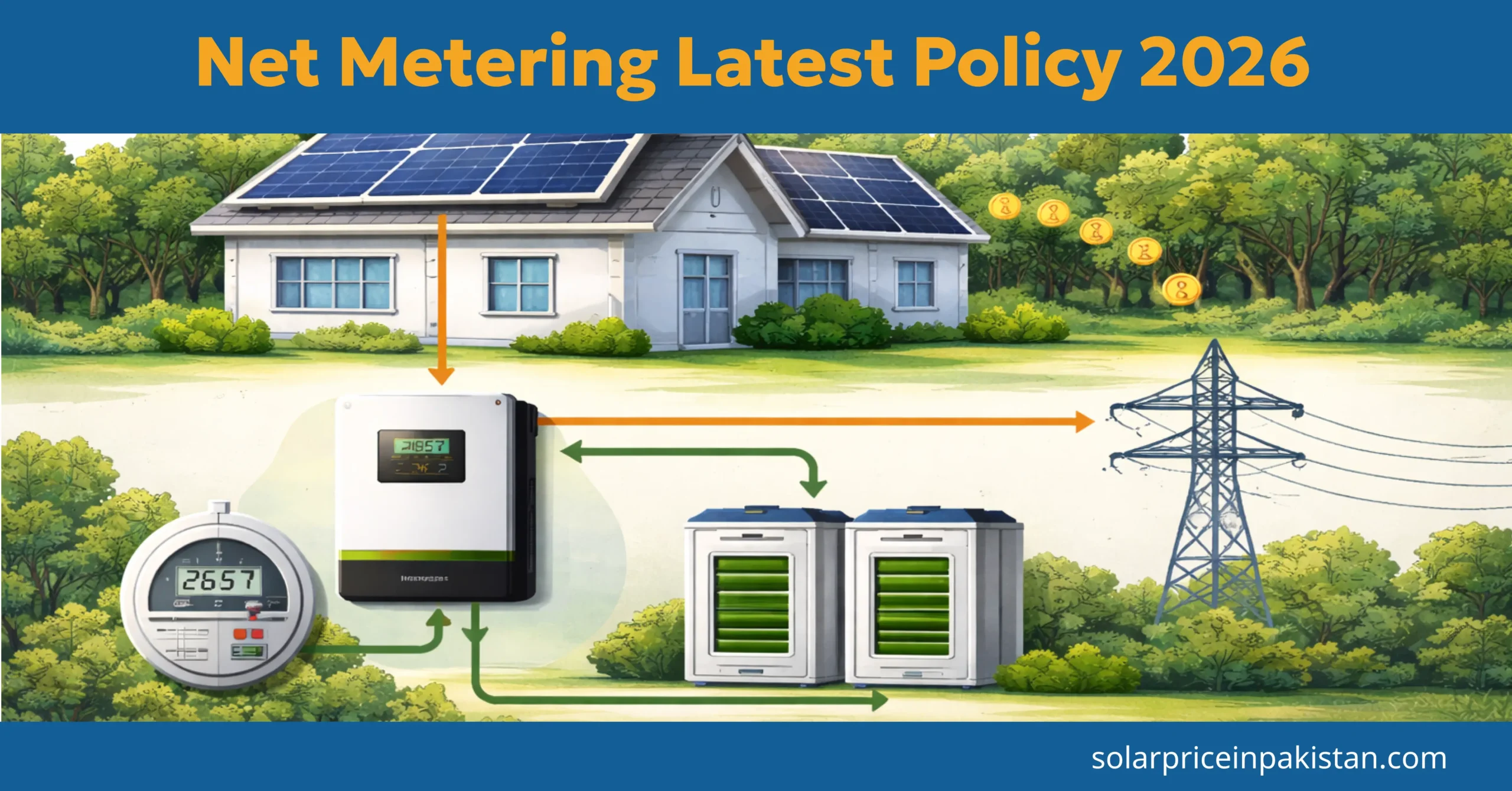
Discover the latest net metering policy 2026 in Pakistan. As Pakistan’s energy environment changes, solar power has emerged as an important component of the nation’s plan to lower carbon emissions, lower electricity costs, and provide clean, decentralized energy solutions to homes and businesses. Net metering, a system that formerly let solar power consumers export excess electricity to the national grid and obtain credits in exchange, is at the heart of this change.
The National Electric Power Regulatory Authority (NEPRA) spearheaded a major government revision of the net metering policy in 2026, moving away from the conventional one-to-one unit offset scheme and toward a more intricate net billing structure. For Pakistan’s present and future solar users, this development has major implications.
In this comprehensive article, we’ll go over the most recent net metering policy, 2026, including how it operates, what has changed, its main advantages and disadvantages, the ramifications for companies and homeowners, and what solar customers need to know to be informed and proactive.
What Is Net Metering in Pakistan?
By use of a regulatory process known as net metering, solar-equipped homes and businesses were able to export excess energy that they did not need back to the grid. Customers received a credit equivalent to one unit of electricity used for each unit (kWh) of solar electricity exported, which helped lower or eliminate monthly electricity payments.
By using the exported solar energy to offset imported grid electricity, rooftop solar users may drastically reduce their electricity expenses under the previous system (2015 regulations), frequently with payback times as short as three to five years.
What Changed in the 2026 Policy?
In early 2026, NEPRA issued the Prosumer Regulations, 2026, which substantially altered the net metering system for all new solar users. Among these modifications are
1. Shift from Net Metering to Net Billing
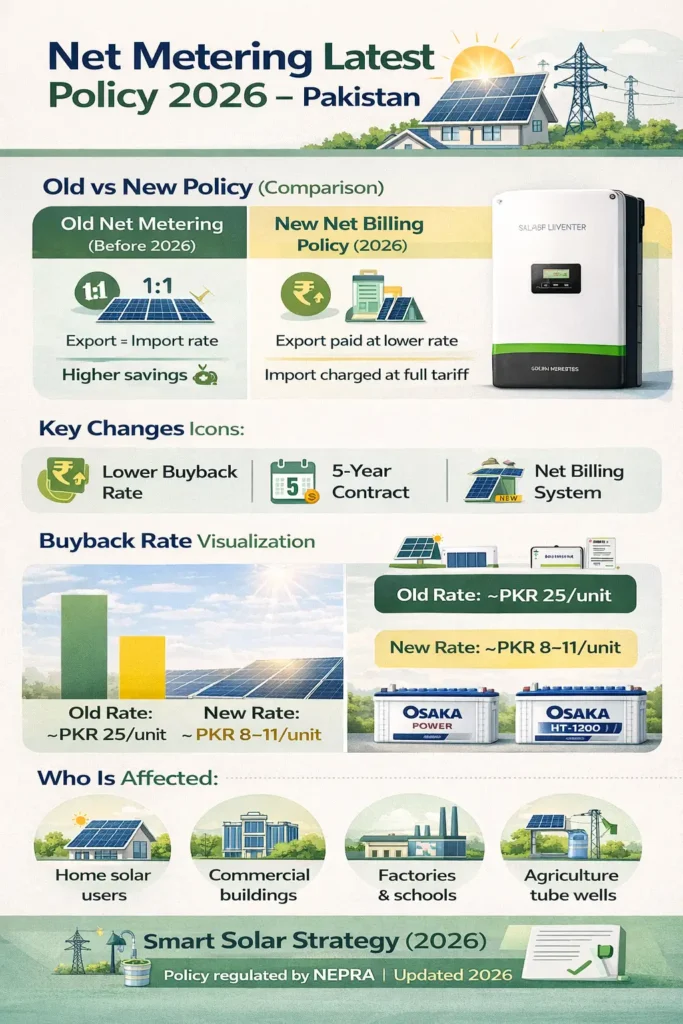
The most significant change is changing to a net billing system from a one-to-one unit offset (net metering).
Under net billing:
- Electricity imported from the grid is paid for by consumers at full retail tariff rates.
- Utility companies buy electricity exported to the grid at a national average energy purchase price (NAEPP), which is frequently significantly less than the retail unit rate.
This effectively removes the traditional unit exchange benefit that made net metering highly attractive.
2. Reduced Buyback Rate
In the past, solar customers could earn about Rs25.9 per unit when they sold excess electricity to the grid. The buyback pricing for excess solar electricity for new customers under the new system is much lower; during policy consultations, it was estimated to be between Rs. 8 and Rs. 11 per unit.
Since consumers now receive significantly less for their exported energy, lower buyback rates have a significant impact on rooftop solar’s economic feasibility.
3. Shorter Contract Term
Solar prosumers entered into 7-year contracts under the previous net metering regulation. The long-term financial calculation for solar investments is altered by the new net billing framework, which shortens this time to 5 years with the option of mutual consent renewal.
4. Expanded Scope Beyond Solar
The new Prosumer Regulations 2026 expand the scope of renewable consumption under the energy laws by extending net billing beyond solar to additional small-scale generators, including wind and biogas systems, up to a capacity of 1 MW.
Impact on Existing Solar Net Metering Consumers
Existing net metering customers who had contracts under the former regime that were still in effect are permitted to continue to be covered under the provisions of their contracts until they expire under the revised policy. Critics counter that depending on how distribution corporations implement the new rules once they expire, even these protections could be degraded.
In order to prevent penalizing 466,000 solar users, Prime Minister Shehbaz Sharif instructed authorities to shield current customers from an excessive burden resulting from the policy change.
How the New Net Billing System Works
In agreement with the 2026 Net Metering (Prosumer) Regulations:
- In accordance with Nepra-approved rates, imported electricity is invoiced at the full retail tariff from the grid to the customer.
- The national average energy purchase price (NAEPP), which is typically significantly less than retail, is used to buy exported electricity (from a consumer’s solar system to the grid).
- Depending on the billing cycles, excess electricity credits are reported either quarterly or monthly.
This creates a pricing imbalance: consumers import at a high tariff but export at a significantly reduced export price.
Economic Implications for Solar Consumers
Reduced Financial Incentives
Because the value of exported power credits drops significantly in comparison to the retail cost of imported units, the switch to net billing lessens the financial appeal of rooftop solar, particularly for systems that are only connected to the grid.
Longer Payback Period
Solar systems frequently pay for themselves in a few years under net metering because of the high unit credits. Without battery storage or self-consumption optimization, solar is less economically attractive due to the lengthy payback period under net billing.
Rise in Off-Grid & Hybrid Systems
Experts believe the new regulation will speed up the deployment of off-grid solar systems with battery storage and hybrid systems that lessen dependency on grid exports for economic returns.
Stakeholder Reaction
The net billing policy has faced mixed reactions:
- Farmers and business associations have strongly opposed the proposed rules, claiming that lower buyback rates and altered billing will raise expenses and discourage the use of solar, especially for agricultural and tube-well operations.
- Despite increased solar penetration and financial stress on utility networks, government officials insist that the transition is aimed at fair pricing and system sustainability.
Pros & Cons of the 2026 Net Metering Policy
Benefits
- Synchronizes solar compensation with the overall economics of the grid.
- Allows for participation in other renewable systems, such as wind and biogas.
- Contracts with shorter durations offer opportunities for regulatory modifications.
Drawbacks
- Removes the one-to-one unit offset, which reduces the possibility for consumer savings.
- Grid-tied solar’s economic appeal is diminished by lower repurchase rates.
- Market confidence is impacted by uncertainty for potential solar investors.
FAQs-Net Metering Latest Policy
Is net metering still available in Pakistan?
Net metering as a one-to-one unit offset regime has been replaced by a net billing system under Prosumer Regulations 2026, but rooftop solar consumers can still connect to the grid and export surplus power for credits under the new structure.
What is the new buyback rate under the 2026 policy?
The new buyback rate for exports is expected to be significantly lower than the previous ~Rs25.9 per unit—discussions indicate around Rs8–Rs11 per unit for new consumers, though final notifications are pending official tariff tables.
How long is a net billing contract valid?
Under the new policy, solar prosumers sign contracts valid for 5 years, reduced from the earlier 7-year term, with renewal possible by mutual consent.
Will existing net metering users lose their current terms?
Existing users with valid agreements are protected until their contract expires. After expiry, they may be transitioned to the net billing framework.
How does this affect solar payback periods?
Since exported electricity is no longer credited at full retail value, payback periods are expected to lengthen, encouraging optimization strategies like self-consumption and battery storage rather than reliance on exports.
Conclusion
The Net Metering Latest Policy 2026 marks a significant shift in Pakistan’s renewable energy policy. In order to balance the adoption of renewable energy sources with grid sustainability and economic realities, the government plans to replace traditional net metering with a net billing model under the Prosumer Regulations, 2026.
The new framework highlights a growing industry where self-consumption, hybrid systems, and energy storage become more significant, even as it lessens financial incentives for exporting solar power to the grid. Anyone thinking about making solar investments in 2026 and beyond needs to be aware of these changes.
Check the latest solar price in Pakistan. Click here