Best 40kW Solar System Price in Pakistan 2026

The transition to commercial solar energy has advanced significantly as electricity prices in Pakistan continue to increase above Rs. 50 per unit and enterprises face hitherto unheard-of energy expenditures. The 40kW solar system is the best starting point for medium-sized to big organizations looking for considerable monthly savings and dependable power backup among the system sizes that are gaining a lot of popularity.
A 40kW solar system is ideal for factories, offices, schools, hospitals, and agricultural operations with three-phase equipment because it is specifically made for commercial businesses that consume between 4,800 and 6,000 units per month. The financial justification for solar energy is greater than ever because commercial electricity rates are currently more than Rs. 65 per unit in many areas. This comprehensive guide explores everything you need to know about the 40kW solar system price in Pakistan, including system types, component breakdowns, installation considerations, and long-term financial benefits.
What is a 40kW Solar System?
A 40kW solar system is a commercial-scale photovoltaic setup engineered to meet the substantial energy demands of medium to large businesses. This system size is ideal for:
- Medium-sized factories and manufacturing units
- Commercial plazas, shopping malls, and offices
- Schools, colleges, and educational institutes
- Hospitals and medical centers
- Agricultural operations (tubewells, cold storage)
- Hotels, restaurants, and large residential compounds
Energy Production Capacity
A properly installed 40kW system generates approximately 160–200 units (kWh) per day, translating to 4,800–6,000 units per month depending on seasonal sunlight variations and system efficiency. Pakistan receives 4.5–5.8 peak sun hours daily, making commercial solar highly viable across most regions.
Who Should Consider a 40kW System?
This system size is perfect for businesses facing:
- Monthly electricity bills exceeding Rs. 300,000–500,000
- Frequent load-shedding disrupts operations
- Need for reliable 3-phase power for machinery
- Rising operational costs due to tariff hikes
40kW Solar System Price in Pakistan: Complete 2026 Breakdown
The 40kW solar system price in Pakistan varies significantly based on system type, component quality, and installation requirements. Based on current market data from multiple Pakistani solar providers, here are the latest price ranges for 2026.
Price Comparison by System Type
| System Type | Price Range (PKR) | Areas with a stable grid, net metering priority |
|---|---|---|
| On-Grid 40kW System | Rs. 3,500,000 – 4,500,000 | Areas with stable grid, net metering priority |
| Hybrid 40kW System | Rs. 4,500,000 – 6,500,000 | Backup required during load-shedding |
| Off-Grid 40kW System | Rs. 6,000,000 – 8,500,000 | Remote areas with no grid access |
Detailed Price Analysis
40kW On-Grid Solar System Price in Pakistan
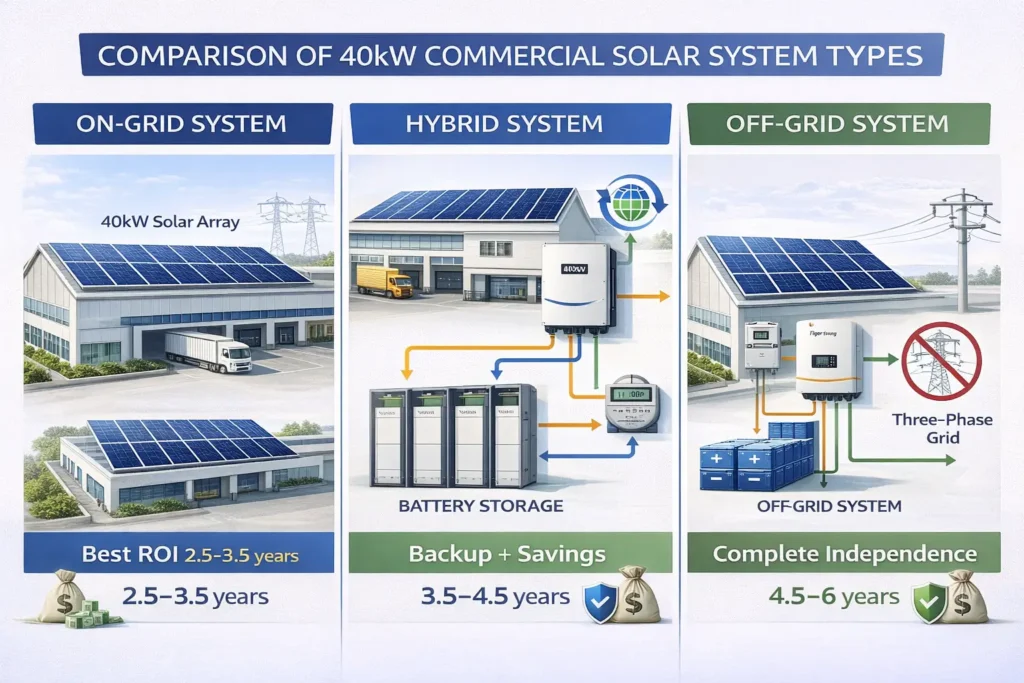
On-grid systems connect directly to the grid and enable net metering, allowing you to export excess electricity for credits. The 40kW on-grid solar system price in Pakistan ranges from Rs. 3.5 million to Rs. 4.5 million. These systems are the most cost-effective option for businesses in areas with reliable grid access and offer the fastest payback period.
40kW Hybrid Solar System Price in Pakistan
Hybrid systems combine solar generation with battery storage while maintaining grid connectivity. The 40kW hybrid solar system price in Pakistan ranges from Rs. 4.5 million to Rs. 6.5 million. These systems are preferred by businesses that cannot afford downtime during power outages.
40kW Off-Grid Solar System Price in Pakistan
For locations without reliable grid access, off-grid systems provide complete energy independence. The 40kW off-grid solar system price in Pakistan ranges from Rs. 6 million to Rs. 8.5 million, including substantial battery banks for nighttime and cloudy-day operation.
Complete System Components and Costs
Understanding the 40kW solar system price in Pakistan requires breaking down individual component costs.
| Component | Specifications | Quantity | Estimated Cost (PKR) |
|---|---|---|---|
| Solar Panels | Jinko/Longi 585W N-type Bifacial | 68-70 panels | 1,200,000 – 1,400,000 |
| Inverter | 40kW Three-Phase Hybrid | 1 unit | 800,000 – 1,200,000 |
| Mounting Structure | GI frame, wind-resistant | Complete | 300,000 – 400,000 |
| Battery Bank (Hybrid) | Lithium-ion or Lead-acid | 15-25 kWh | 1,000,000 – 2,500,000 |
| Wiring & Protection | DC cables, breakers, SPD | Complete | 150,000 – 250,000 |
| Installation & Engineering | Professional installation | Complete | 200,000 – 300,000 |
| Total (On-Grid) | Rs. 3,500,000 – 4,500,000 | ||
| Total (Hybrid with Batteries) | Rs. 4,500,000 – 6,500,000 |
Solar Panel Options for 40kW Systems
For a 40kW system, you have several panel options depending on wattage:
| Panel Wattage | Number of Panels Needed | Panel Technology | Total Panel Cost (PKR) |
|---|---|---|---|
| 550W | 73 panels | Standard Mono | 1,200,000 – 1,400,000 |
| 585W | 68-69 panels | N-type Bifacial | 1,300,000 – 1,500,000 |
| 600W+ | 66-67 panels | Premium Bifacial | 1,400,000 – 1,600,000 |
Key Features of Commercial 40kW Solar Systems
1. Three-Phase Power Capability
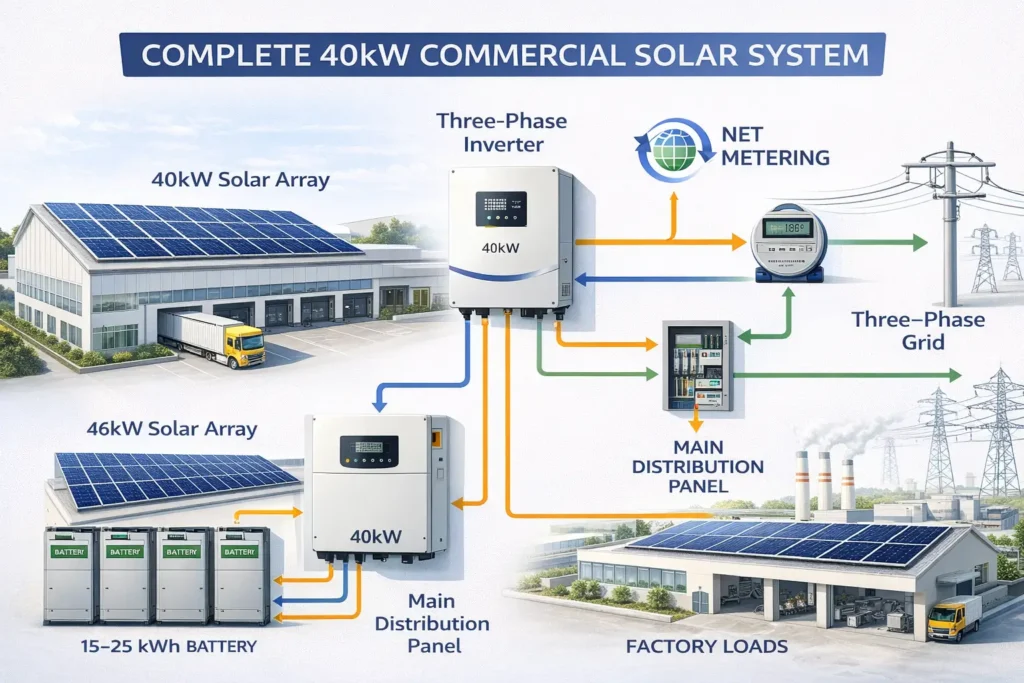
Commercial 40kW inverters deliver three-phase output (380V/400V), essential for running industrial machinery, commercial ACs, and heavy equipment.
2. Multiple MPPT Trackers
Modern 40kW inverters feature 2-3 MPPTs, allowing optimal performance even with panels facing different orientations or experiencing partial shading.
3. Advanced Monitoring & SCADA
Commercial systems include remote monitoring capabilities, allowing business owners to track energy generation, consumption, and savings in real-time via smartphone apps or web portals.
4. High Efficiency (97-98.6%)
Premium 40kW inverters achieve conversion efficiencies up to 98.6%, ensuring maximum energy harvest from your solar array.
5. IP65/IP66 Weather Protection
Commercial inverters are rated for outdoor installation with dust-tight and water-resistant enclosures, perfect for Pakistan’s challenging climate.
6. Grid Support & Export Capability
On-grid and hybrid systems support net metering, allowing businesses to export excess energy and receive credits on their electricity bills.
Types of 40kW Solar Systems for Commercial Use
On-Grid Commercial Systems
On-grid systems connect directly to the grid and operate without batteries. They are the most affordable option and enable net metering, allowing you to sell excess electricity back to the grid.
Advantages:
- Lowest upfront cost (Rs. 3.5-4.5 million)
- Net metering reduces electricity bills by 70-90%
- Simple design with fewer components
- Fastest payback period (2.5-3.5 years)
Disadvantages:
- No power during grid outages
- Requires a stable grid connection
Hybrid Commercial Systems
Hybrid systems combine solar generation with battery storage while maintaining grid connectivity. They are the most popular choice for Pakistani businesses facing frequent load-shedding.
Advantages:
- Complete protection from load-shedding
- Net metering compatible
- Battery storage optimizes self-consumption
- Energy security for critical operations
Disadvantages:
- Higher initial cost than on-grid (20-30% more)
- Battery replacement is needed every 5-8 years
Off-Grid Commercial Systems
Fully independent from the grid, these systems are ideal for remote industrial sites or locations where grid access is unreliable or unavailable.
Advantages:
- Complete energy independence
- No reliance on grid stability
- Works in remote areas
Disadvantages:
- Highest initial investment
- Larger battery banks required (30-40% of system cost)
- No net metering benefits
Space Requirements for 40kW Solar System
A 40kW solar system requires significant roof or ground space:
- With 585W panels: 68-70 panels needed
- Area required: 160-180 square meters (approximately 1,720-1,940 square feet)
- Requirement: Open, shadow-free space with proper orientation (south-facing preferred)
For ground-mounted installations, additional space may be needed for access pathways and equipment placement.
Commercial Applications of 40kW Solar Systems
| Business Type | Typical Load | Why 40kW Works |
|---|---|---|
| Textile Factory | Multiple machinery units | Covers daytime peak demand |
| School/College | ACs, labs, computer rooms | Reduces operational costs significantly |
| Hospital | Critical equipment, ACs, lights | Provides backup during outages (hybrid) |
| Shopping Plaza | Elevators, ACs, lighting | Peak load during business hours |
| Rice Mill | Motors, dryers, pumps | High daytime consumption |
| Cold Storage | Compressors, freezers | Constant power need, excellent ROI |
Financial Benefits and ROI Analysis
The 40kW solar system price in Pakistan represents a significant investment, but the financial returns for businesses are compelling.
Monthly Savings
- Daily generation: 160-200 units
- Monthly generation: 4,800-6,000 units
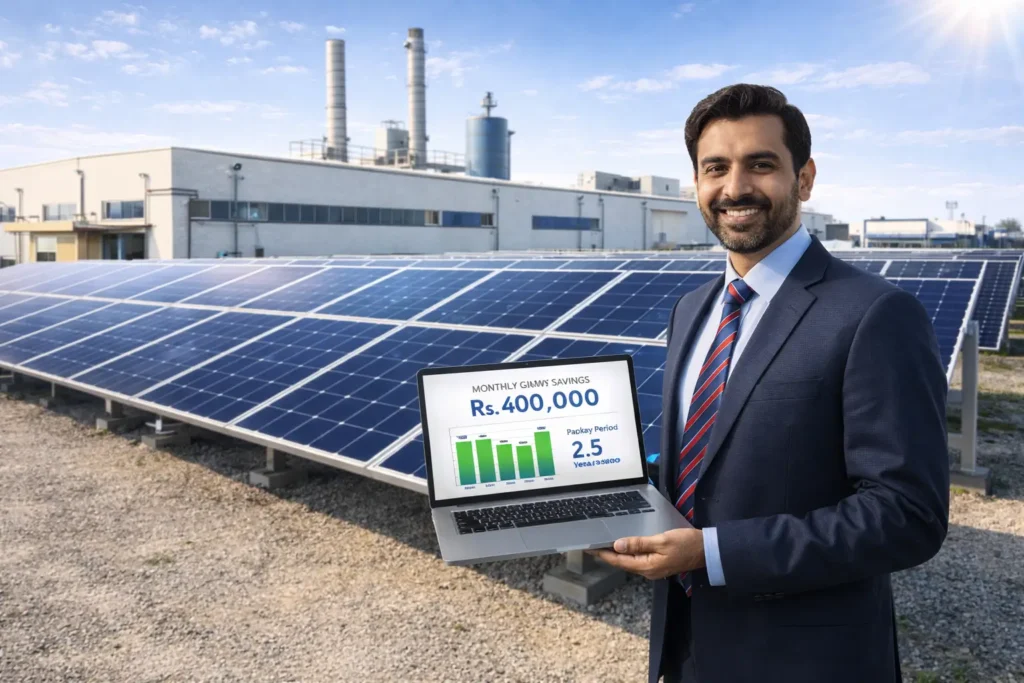
- Monthly bill reduction: Rs. 300,000 – 500,000 (at commercial tariffs)
- Annual savings: Rs. 3.6 million – 6.0 million
Payback Period
- On-grid systems: 2.5 – 3.5 years with net metering
- Hybrid systems: 3.5 – 4.5 years, depending on battery configuration
- Off-grid systems: 4.5 – 6 years
Long-Term Value
With a system lifespan of 20-25 years, businesses enjoy 15-20+ years of nearly free electricity after the payback period. This represents lifetime savings of Rs. 70-120 million.
Sample ROI Calculation (40kW On-Grid)
| Metric | Value |
|---|---|
| System Cost | Rs. 4,000,000 |
| Monthly Savings | Rs. 400,000 |
| Annual Savings | Rs. 4,800,000 |
| Payback Period | 2.5 years |
| 25-Year Lifetime Savings | Rs. 115,000,000 |
Factors Affecting 40kW Solar System Price in Pakistan
Several variables influence the final cost of 40kW commercial systems:
1. Brand and Panel Technology
Tier-1 brands like Jinko, LONGi, and JA Solar command premium prices but offer better warranties, higher efficiency, and reliable performance. N-type bifacial panels cost more but deliver a higher energy yield.
2. System Type
On-grid systems are most affordable, hybrid systems offer backup power at moderate cost, and off-grid systems require the highest investment due to battery banks.
3. Inverter Quality
Premium inverters from Huawei, Sungrow, or GoodWe cost more but provide better efficiency (up to 98.6%), longer warranties (10 years), and superior after-sales support.
4. Battery Selection (for Hybrid/Off-Grid)
Lithium-ion batteries cost 2-3 times more than lead-acid but offer longer cycle life, deeper discharge capability, and maintenance-free operation.
| Battery Type | Cost per kWh | Lifespan | Maintenance |
|---|---|---|---|
| Lead-Acid | Rs. 15,000 – 25,000 | 3-5 years | High (water topping) |
| Lithium-ion | Rs. 30,000 – 45,000 | 8-12 years | Minimal |
| LiFePO4 | Rs. 35,000 – 45,000 | 10-15 years | Minimal |
5. Installation Complexity
- Roof type: Flat, sloped, or ground-mounted installations affect material and labor costs
- Site accessibility: Difficult access increases installation time and cost
- Distance from grid connection point: Longer runs require more cabling
6. Market Dynamics and Import Policies
In 2026, solar panel prices in Pakistan have increased by approximately Rs. 10 per watt due to global raw material inflation (silver, copper, polysilicon) and currency fluctuations. Additionally, China’s removal of export VAT exemptions on photovoltaic products, effective April 2026, is expected to further increase module costs by 9-10%.
Net Metering for 40kW Commercial Systems
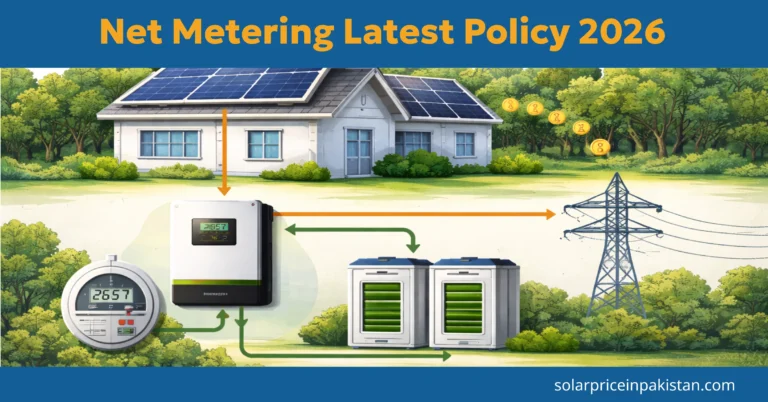
How Net Metering Works
Net metering allows businesses to export excess solar electricity to the grid and receive credits against their consumption. For a 40kW system:
- You use solar power during daylight hours
- Excess generation flows to the grid
- You draw from the grid at night using accumulated credits
- Credits reduce your monthly bill, often by 70-90%
New Regulations (2026)
In December 2025, NEPRA approved new “Prosumer Regulations,” moving from net metering to a net billing model for new applicants:
| Feature | Old Net Metering | New Net Billing (2026 onward) |
|---|---|---|
| Buyback Rate | ~Rs. 27/unit | Rs. 11/unit |
| License Duration | 7 years | 5 years |
Net Metering Application Process
Your solar installer handles the DISCO application process. Approval typically takes 4-8 weeks for commercial systems.
Commercial Solar Success Stories
Textile Factory – Faisalabad
A textile factory with a monthly electricity bill of Rs. 1.2 million installed a 40kW on-grid system. Result: Monthly bill reduced to Rs. 180,000 (85% reduction). Payback achieved in 28 months.
Rice Mill – Gujranwala
A rice mill facing frequent load-shedding installed a 40kW hybrid system with battery backup. Result: Zero production downtime during outages, monthly diesel savings of Rs. 150,000, payback in 3 years.
School – Lahore
A private school with 15 classrooms and 30 ACs installed a 40kW on-grid system. Result: Electricity bill reduced from Rs. 450,000 to Rs. 90,000 monthly. Savings redirected to educational resources.
Installation Timeline for 40kW Commercial Systems
| Phase | Duration | Activities |
|---|---|---|
| Site Survey & Design | 3-7 days | Load assessment, structural analysis, system design |
| Equipment Procurement | 7-14 days | Panel/inverter sourcing, structure fabrication |
| Installation | 7-10 days | Panel mounting, inverter installation, wiring |
| Testing & Commissioning | 2-3 days | System verification, performance testing |
| Net Metering Application | 4-8 weeks | DISCO documentation, meter installation |
| Total | 6-12 weeks | From contract to full operation |
Conclusion
The 40kW solar system price in Pakistan represents a strategic investment for businesses seeking to reduce operational costs, achieve energy independence, and protect against rising electricity tariffs. There is a commercial solar system for any business need, with costs ranging from Rs. 3.5 million for on-grid configurations to Rs. 8.5 million for full off-grid options.
On-grid systems with net metering provide the quickest return on investment (usually 2.5–3.5 years) and a 70–90% decrease in monthly electricity bills for the majority of commercial enterprises with reliable grid connectivity. Hybrid systems offer businesses in load-shedding-prone locations the perfect mix of cost savings and security, guaranteeing continuous operations even in the event of grid interruptions.
Solar prices may continue to climb in 2026 due to recent market trends, such as the price increase of Rs. 10 per watt and China’s impending adjustments to its VAT policy. In order to lock in current rates, businesses contemplating solar investment may find it advantageous to take action as soon as possible.
Prioritize competent engineering and installation, high-quality components from Tier-1 manufacturers, and extensive after-sales assistance when assessing the cost of a 40kW solar system in Pakistan. Over the course of the system’s 25-year operational lifespan, the initial premium for high-quality equipment pays out in the form of increased energy yield, a longer system life, and lower maintenance expenses.
As Pakistan’s commercial electricity tariffs continue to rise and grid reliability challenges persist, the 40kW solar system delivers the power, reliability, and savings that medium to large businesses demand for long-term success and sustainability.
Check the latest solar price in Pakistan. Click here
FAQs
What is the 40kW solar system price in Pakistan in 2026?
How many units does a 40kW solar system produce per day?
A properly installed 40kW system produces 160-200 units (kWh) daily, depending on seasonal sunlight and system efficiency. This translates to 4,800-6,000 units monthly.
How much space is needed for a 40kW solar system?
A 40kW system requires approximately 160-180 square meters (1,720-1,940 square feet) of open, shadow-free space.
What is the payback period for a 40kW commercial solar system?
How much area do I need for 40kW solar panels?
Using 585W panels, you need approximately 68-70 panels covering 160-180 square meters of roof or ground space.
Which solar panels are best for a 40kW system in Pakistan?
What is the warranty on commercial solar systems?
Solar panels: 12-15 years product warranty, 25-30 years performance warranty
Inverters: 5-10 years (extendable)
Batteries: 2-10 years, depending on technology
Installation: 1-2 years of workmanship warranty, typically
Can a 40kW system power a factory?
Yes. A 40kW system can power medium-sized factories with multiple machines, ACs, lighting, and office equipment during daytime hours. For 24/7 operations, a hybrid or off-grid system with adequate battery storage is recommended.
Is financing available for 40kW commercial solar systems?
Yes. Several banks in Pakistan offer solar financing for commercial projects. State Bank of Pakistan provides subsidized loans for renewable energy projects at competitive rates.